Thanks Crabman for putting up a thread with your proposal. I’ve been following this discussion in the unofficial channels and it was time to have a proper place to talk about it.
TLDR
While the concept is valid and more natural than SER, I don’t think that it is wise to implement it. The idea of balancing emissions is not correctly justified and the bounding of minting to relay volume without a paired burn mechanism was the cause of the initial surge in inflation of the Pocket Network.
Full Answer
I think that there are some problems with this proposal, I will try to separate them into categories.
Bounding minting with relay volume
I like the idea of coupling emissions to relay volumes, this is the way Pocket is supposed to work. I have mentioned a few times that the decoupling of relay growth from income growth is not natural and creates a dissociation between the sales objectives and the node runners objectives. However I think that we are not ready to bound emissions to relay volumes again (like before WAGMI).
Over the last year the number of daily relays has increased from ~800M to 1.2 B, this is an increase of 50%. We expect this increase to be even higher this year if sales objectives are met and removal of free traffic does not compensate all sales.
The scenario of relay growth is not taken into account in the provided tables.
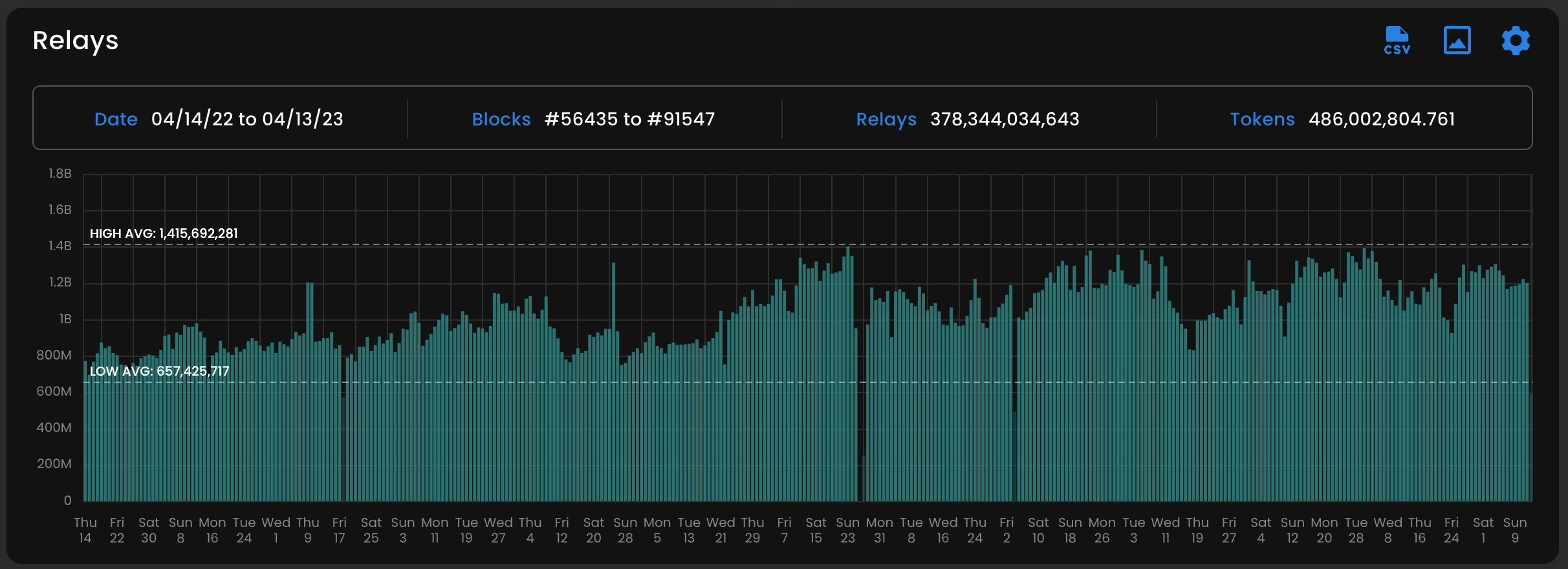
Since there is no burning mechanism, the emissions were decoupled from relay volume to avoid this situations, where increasing the relay volume (something positive) results in uncontrolled emissions (something negative).
Inflation Balancing
You write about “balancing out inflation” and how many sales are needed to compensate emissions, the problem is that the sales are not network profit as @Caesar points out in his blog post. PNI will never buy back and burn 100% of their sales incomes because that’s not how they work (reference needed).
Until burn is activated and each relay done translates into burning, there will be no “balancing” of emissions. This is true for SER and would be true for RDI (this proposal).
Relay Pricing
Setting the price of the relay has lots of implications, it is not only fixing a cost, you are in fact fixing the real exchange rate of $POKT to a value controlled by a third party (in this case Infura). This might sound weird here but we will be posting shortly (next week?) something about the macro-economic mechanisms of the Pocket Network, and the relative price of a relay in the Pocket ecosystem to the price of a relay outside Pocket is a fundamental variable that we should be able to control.
Also, the PNI portal page states that the cost of a relay is U$D 0.000007456, that’s 26 times lower than the proposed value. This means that any client of “Pay as you go” plan will have a massive increase of their price tag. As you say, Pocket Network is not perfect and we have issues of data integrity (that hopefully will be solved in portal V2), will the clients accept this or they will just fly of to Infura for the same price tag?
Also a note on the free relays, they are not part of the protocol, each relay must be paid for (meaning that each relay will burn POKT stake in the future). Free relays can be given but someone will have to pay for them, PNI, the portal operator or the community (through DAO).
Calculations - Study cases
You provide tables (please share the google sheet if you can) for a single study case:
What if the price goes up? (ceteris paribus the rest of the variables)
You show in this case how the SER would mean that more U$S are “printed” (I disagree with presenting this figure in U$D tho), on the other hand the RDI would keep that value constant.
But what about the other variables?
- What if the price stays constant or goes down while the number of relays goes up? (current scenario of the Pocket Network)
I feel that we would need to observe other cases, not just the “happy path” of the proposal.
Network Cost and Node Running
I feel that we talk about network cost and node running costs very lightly. I would like to see some number behind the claims like:
In my experience this is not true, the Pocket Networks is already in low/none-profit for many node runners. These claims often overlook the human resources part of the equation (which are fundamental to the Pocket community).
I also don’t understand why this will be true:
If a node provider gives you 75% of 12 POKT a day you will earn 9 POKT, but if you stake 2-3 chains in a single region with no-so-good QoS you will be below 9 POKT (you can check this on POKTscan).
With lower emissions the first to die will be the smaller ones, big ones will only feed on the increased share of emissions that are going to be released by smaller NR who capitulate. You are encouraging centralization.
This is bad for the Pocket Network, this will drive us back to pre-GeoMesh QoS distribution (some more info in the GeoMesh thread):
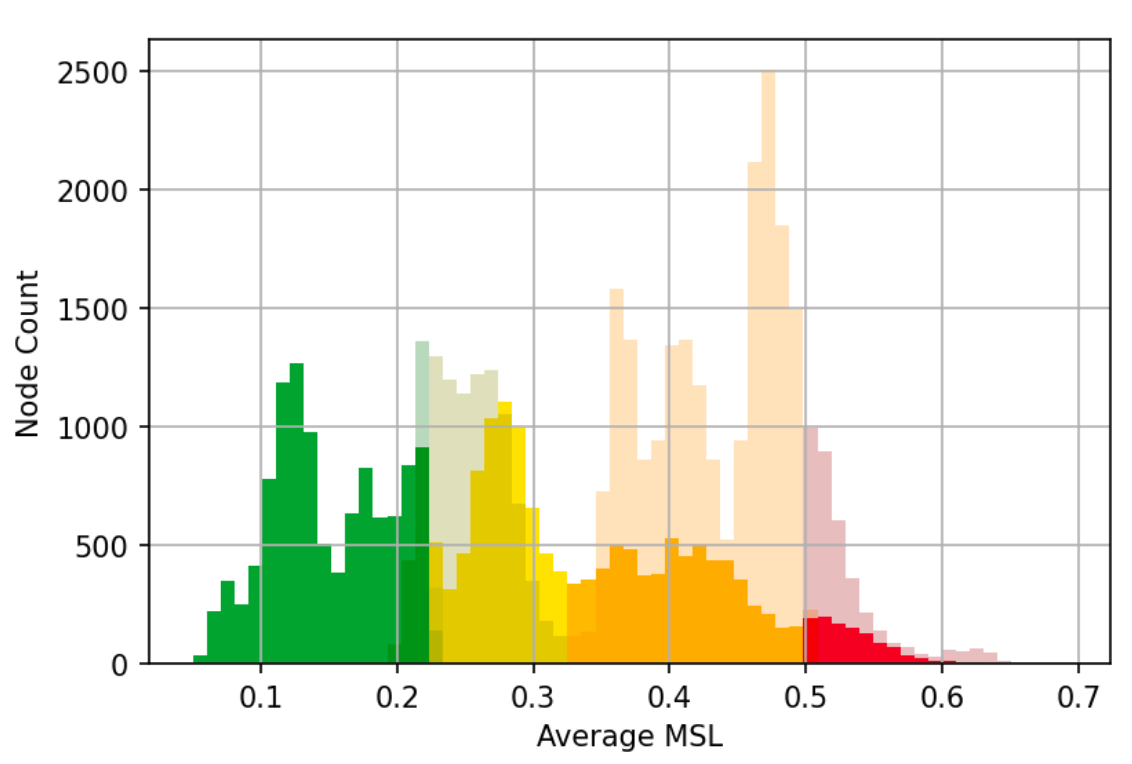
(and this is an outdated image, from GeoMesh release, now we are even better)
The only way to remove geomesh without impacting the QoS is by regional staking, and that would come in V1. If you want to help small node runners and optimize hardware usage, I have already proposed more restrictions for V1 here.
This is a common misconception, we cannot measure over-provision by counting Pocket nodes. The quote is very outdated, you can ask @poktblade if he still thinks that a Pocket Node is something to take into a account when measuring the cost of a node running operation.
All arguments based on this are not valid. The network can run with a single 15K node for each real provider, but that will not happen because we are greedy, secretive and internet annons.