It would be designed to provide an even playing field for liquid or currently staked POKT.
At the moment, there are 1000 validators. That could change via a proposal.
I’m open to further deceases, but every time I’ve proposed something to this extent, it’s been HIGHLY unpopular. I’ll point to: PUP-12: Inflation Stop-Gap Proposal: Double Trouble as an example. I built in a mechanism for accelerating decreases to the mint rate above and beyond a proportionate decrease. That would look something like this @lex :
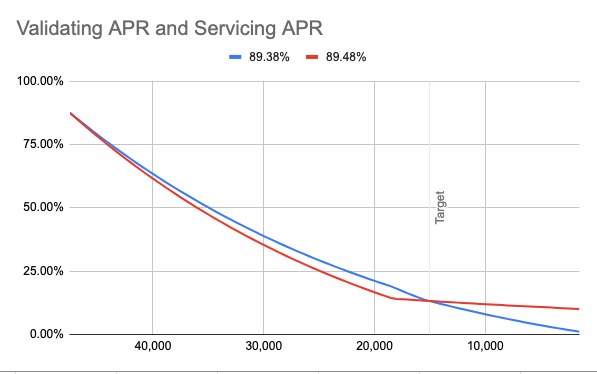
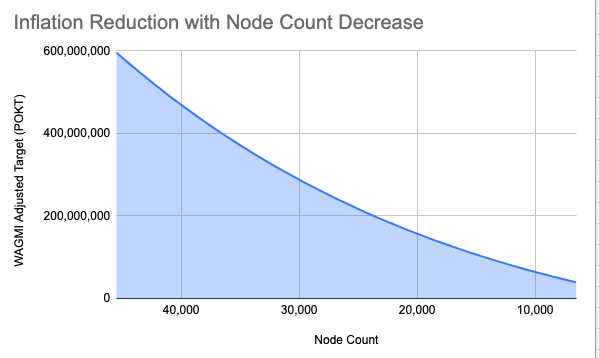
Inflation would be about 105M at the MVNC. If I hear others call for this, I’ll edit the proposal.
Looks like an oversight. I’ll get in there and correct things. Thanks @addison.
While I’m heavily in favor of the idea of the light client, I am thinking that there is a non-zero cost to the light client, as light as it may be. Meaning at the end of the day, more clients = more costs. According to Addison, these costs are very much non-zero At 50% of the cost, low long until we’re at 80K or even 160K nodes? What does that mean for network cost? It’s a little too early, in my opinion, to consider that the silver bullet until it plays out in reality. Further, why not do both? Operate at a more ideal node count, with very low costs? Seems like a win-win to me.
In an ideal scenario, this would be well coordinated and node runners would have a chance to get ahead of the changes meaning that changes wouldn’t take effect until everyone has had a chance to make their moves. It should be an even playing field. If someone does want to front-run, they’d be securing the network.
We’ve seen this continually with launching new service nodes; therefore, I’m not sure I follow the logic. Further, unstaking penalties make it costly to marginally decrease your stake.
At current costs, it definitely is. Post-light client, we will see. To your point, I think you can have the best of both. Liquid POKT is staked on validators (great) and we have low cost servicers with the light client (also great). I think where the rubber meets the road is with node running services which will offer validation services that put little strain on the market.
Let’s do both?
I’m convinced that incentives overcome the complexity that this introduces.
Given PUP-14: Increase MaxValidators to improve economic security - #29 by addison, it feels like we need this. The simple solution would be to just up the validator incentive arbitrarily, but I think you run the risk of migration back to servicing if not dynamically adjusted, jeopardizing network security.
Keep in mind that there is a 15 chain limit per servicer. It’s not like costs per servicer vary based on how many chains Pocket Network Supports.
I think this is a separate issue that GOOD VIBES does not intend to address. See below: