Hi all - this is targeted at the community at large since Fred and I already had a conversation with the economics committee and PNF about this over the weekend. We agree that we need to turn on token burning, and not just in a symbolic way, so we are throwing our support behind this proposal.
The goal of this post is to give everyone an understanding that this may affect Grove’s book of business.
Presently, we charge $2/mil requests, which doesn’t yet fully cover our costs of operations (but we’re getting close). Adding $2.50 on top of that as the fee to the protocol will change our cost structure that we’ll be passing onto our customers. We’ve won or retained most deals due to being competitive on price, non compute-unit pricing, and the large selection of chains Pocket provides. We’re not ignorant to the fact that this has only been feasible because all token holders have been subsidizing relays through endless inflation.
We also know that the goal of the Grove, an open source and engineering-focused R&D team, is to:
- Build the protocol
- Build PATH ← Growing decentralized demand on Pocket
- Monetize PATH ← We’re going to pivot here later this year
B2B/B2C sales of raw RPCs may no longer be viable for us, and that’s OK, because we’re an R&D shop. Our goal was to prove we could build a protocol like Pocket and that people would pay for the service on top of Pocket. We’ve proven both and now it’s time to mature the whole network to make the protocol viable.
We’re not going to give up the RPC business. We’re going to raise our prices for our paid tier and add the ability to pay us in POKT (these are hypothetical):
- $5/mil requests (if you pay in USD)
- $4/mil requests (if you pay Grove in POKT)
Doing it this way will give customers the opportunity to add buy pressure on the open market. It will also push Grove to sell PATH. This will include building ancillary features that we need to build for PATH, such as staking POKT automatically on an application-level basis, POKT-based payment processing and others needed by users.
In the event we lose relays, the Foundation is working on a staking program with node runners to make sure the stability gained with F-Chain subsidies and previous RTTM changes continues to keep the network stabilized.
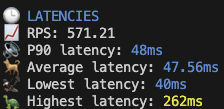
Finally, we believe we’ll be able to justify this price increase because PATH guarantees Enterprise-grade Quality of Service on top of Pocket Network. We’re proud to share preliminary data showing that PATH’s QoS is on-par, if not better than, centralized, vertically integrated RPC providers. Below is an example of a load test on PATH through Shannon - latencies are REALLY low.
With the quarterly refund, raising prices, and our work on lowering our infra costs that we had slated for this month and next, we believe we should still be able to hit profitability on the RPC business this year given a bunch of other changes we made in the first quarter of this year.