Thanks @JackALaing for this recap. To add more to the Gateway Stack:
The Nodies Gateway Stack aims to streamline the integration of applications with the POKT Network, reducing the complexity associated with directly interfacing with the protocol with an all-inclusive stack that any developer can contribute to. This allows for mass adoption across multiple personas such as application developers, existing centralized RPC platforms, future gateway operators, and more.
Whenever proposing and pioneering the pathway to multiple gateways and its benefits to the Foundation, they opened up with open arms to enable us. Whenever we wrote the initial technical specification, the reason why it felt “ambiguous” to some was to prevent being locked into a granular statement of work given that the potential scope of this project is extremely large and to reduce the friction of unnecessary bureaucracy. The specifications were structured in such a way that the ecosystem would always benefit. Our team continues to push the limits of what we can actually do for the ecosystem based on our expertise and experience with the protocol and as a RPC provider, ultimately leading us to the gateway stack.
So what exactly is the gateway stack right now? The gateway stack kickstarts off as a light-weight process that enables developers of all kinds to be able to interact with the protocol and engage with 50+ blockchains without the need of storing terabytes of data, require heavy computational power, nor understand the POKT protocol specifications with a simple docker compose file. The rhetorical question that we pose to future actors who want to maintain a blockchain node is: Why spin up an Ethereum node and maintain it yourself whenever you can just leverage POKT natively using the Gateway stack? Afterall, using POKT would require a fraction of the required resources and technical staffing.
We envision that the stack will be used as a foundation for their entirety of the ecosystem to continue to build on top of such as:
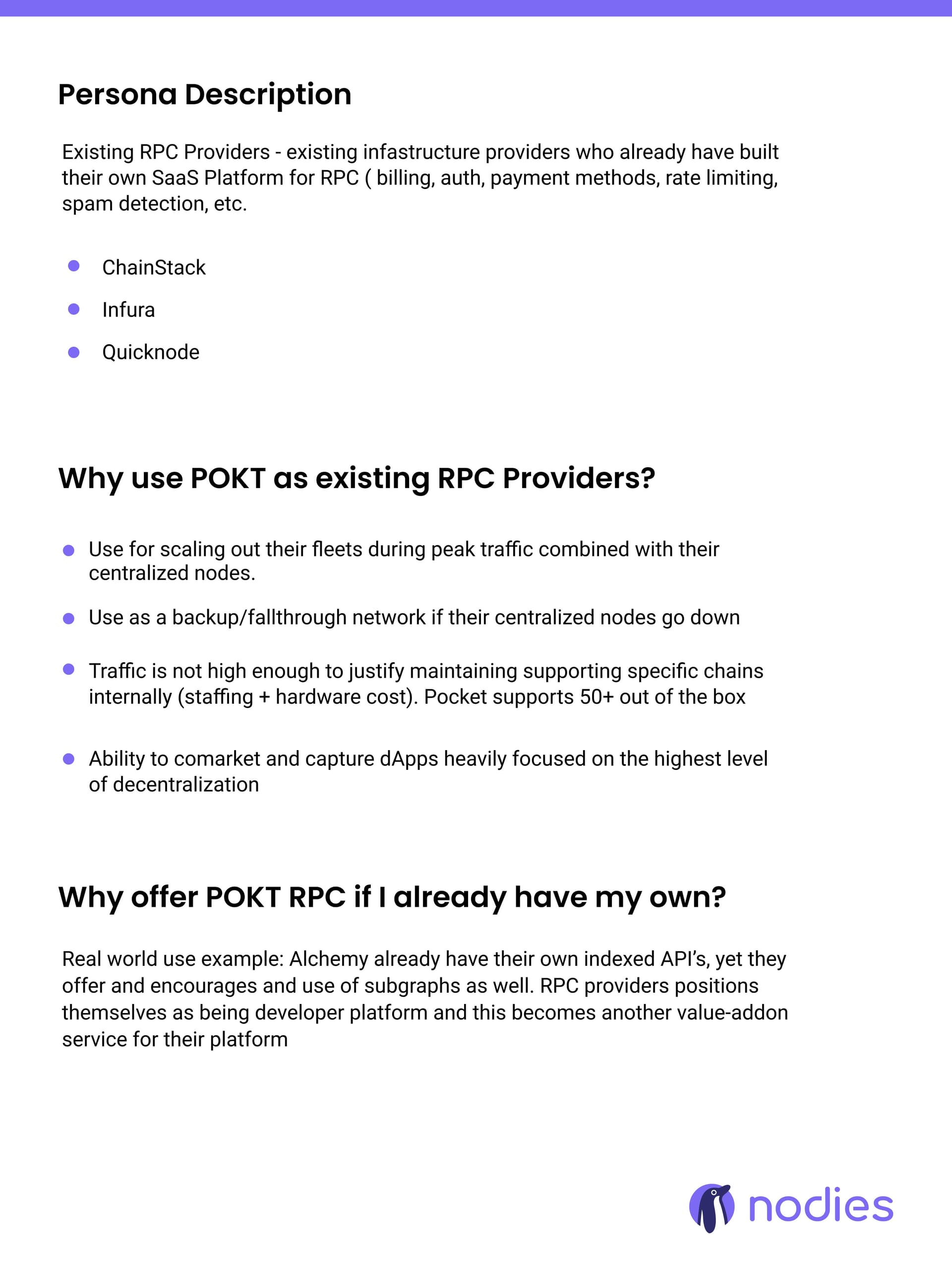
- Building their own frontends and extending their backend to include POKT by using the Gateway stack for their own SaaS business
- Using POKT as a hyperscaler whenever they need more computational power or access to more blockchains (sticking the process into their LB rotation)
- Using POKT as a backend as a failover whenever their centralized nodes goes down (sticking the process into their LB rotation)
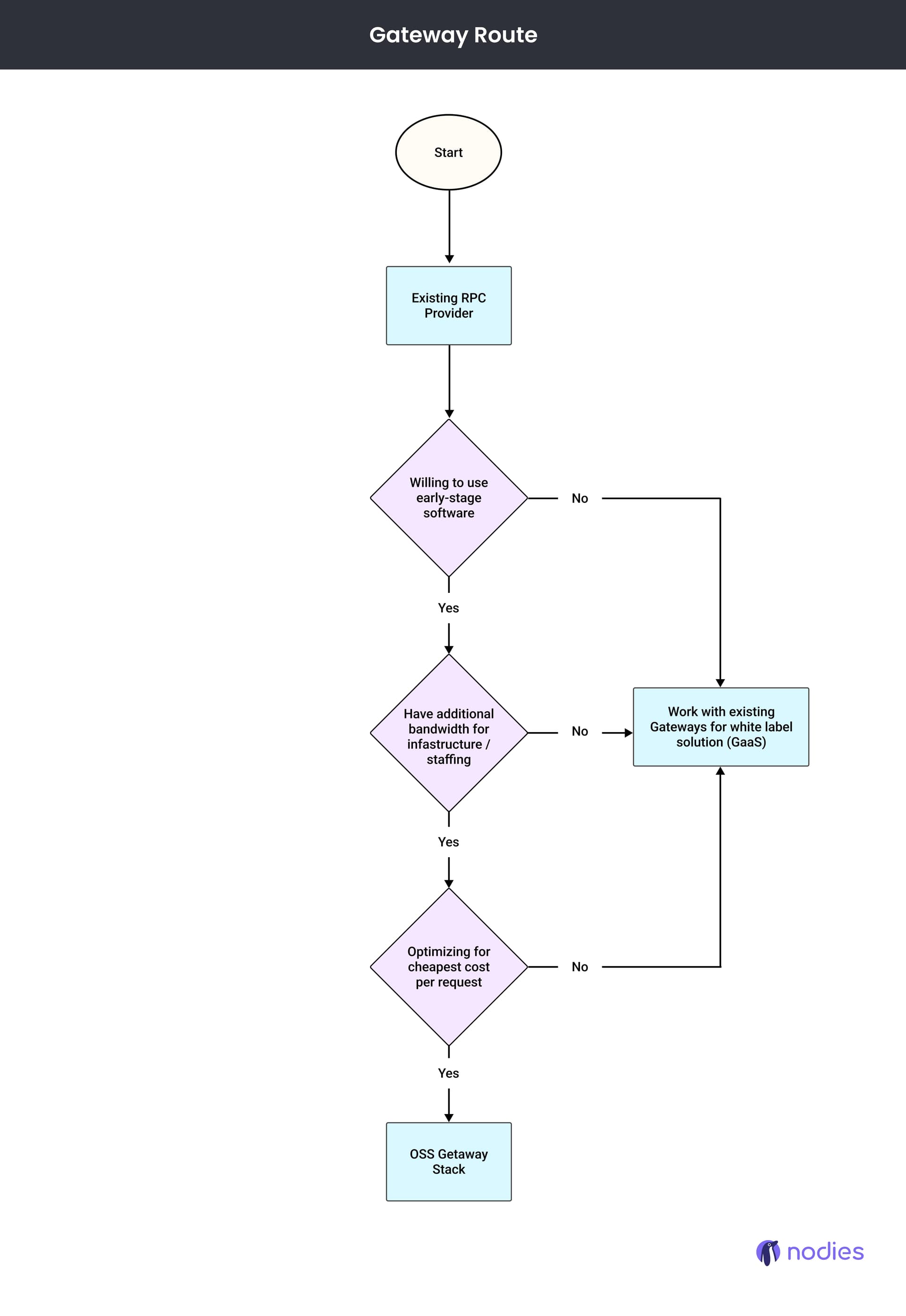
The use cases are limitless and we expect that over time, community contributions into the gateway stack will enable some of the aforementioned use cases natively. Below is an example persona we’ve created to illustrate how existing RPC providers can use POKT through the Gateway Stack.
Next steps
Our plans for this December and January to transition from alpha to RC ready ordered by priority:
- Enable QoS checks that will allow Pocket responses to return with a 99% success rate.
- Enable Observability on the gateway server to measure success, error, session dispatching rates (Allow for Prometheus to scrape these metrics)
- Create E2E test coverage that allows for a reliable release process.
- Create documentation and architectural diagrams to elaborate on the existing state of the stack
- Assist the Foundation to help onboard more gateway operators
Our goal is that by the end of the 6 month period, the fundamentals of the Gateway stack are sound, and there is a sustainable and realistic way for many more community contributions down the road. Our team will continue to own the direction and vision of the project to prevent any unnecessary thrashing. However, we welcome any discourse within reasonable bounds and our roadmap will continue to be shaped by future gateway operators who will onboard the network.
Please note that the actual deliverables that we are committing to has not changed, the Nodies Gateway Stack exists to house these deliverables but as well set a long-standing vision for future contributions. The end state of the Gateway stack will continue to evolve, however the next two months are now granularly set to baseline the expectations.
Objectively taking a step back and looking at the larger picture..
To dive deeper into our accomplishments, we frame it in respect to the objectives outlined in the OP and the timeline which is about the hafl way mark of the total engagement as far:
There was a clear need to define processes for future gateway operators (i.e gateway docs, relay specification, app stakes distribution mechanism, identifying the need to securely rotating the app stakes, contractual agreements, etc). We have been actively working with PNF to help remove these logistical barriers. As a result, these processes will be then distributed to the next 2-5 gateway operators that will be onboarding the network in the upcoming quarters.
 On track
The grant’s purpose allowed us to build both inwards and outwards. Both of these characteristics go hand to hand, and the POKT ecosystem does benefit from both. It was always our intention that https://nodies.app would directly integrate with the protocol as a first step and to focus time and energy on building out BD/Sales for POKT. Then we would fan that out into a more open source-project to help further gateway operators onboard.
We are now powering anywhere from 50m to 80m POKT traffic a day at a 60% cost reduction in comparsion to previous gateway offerings. This only cements that multiple gateway operators will be a net add for the ecosystem. Furthermore, this is a huge step forward for the POKT ecosystem because:
-
POKT’s traffic is now more resilient than ever. Gateways now are operating on multiple different infrastructure stacks leading to a further resilient network as gateways are spread across multiple PoPs ranging from GCP to Bare Metal.
-
By directly integrating, this has led us to learn more about what it actually takes to become a gateway operator and ultimately strategize on what we would need to solve for in order to reduce the friction in gateways. Ultimately, this was one of the major contributing factors to our open source gateway stack vision and the actual OS Gateway stack.
On track
By directly integrating with the protocol and serving real world traffic, this has given us sufficient information on more QoS checks we would have to perform, and where we can optimize. This has already been reflected in our cost savings for the Network and why the gateway stack is so focused on performance and effiency. Furthermore, the prortocol team has already reached out to us to talk more about Gateways in general and where the OS Gateway stack fits in a post Shannon world.
On track
We already have our platform hooked into the network powering public RPCs. By the end of Q2, the foundation has set a goal of 2-5 gateway operators being able to also power POKT RPC. There have been numerous queries behind the scenes from both ecosystem members, node runners, and even centralized providers on leveraging our gateway stack. The rate that we are going, there will be plenty of actors who can potentially be tapping into the network for RPC on the demand side, ultimately cementing that the POKT Protocol is the only decentralized RPC network on both the supply and demand ends.
On track
Closing Statement
Our recent efforts have made significant strides in achieving the outlined objectives within the past ~3 months. From removing logistical barriers for future gateway operators to supporting a second-mover gateway, learning about gateway operations, fostering innovations in technology, and diversifying revenue sources, Our integration and contributions have demonstrated tangible progress. The achievements so far continue to pave the future for a multi-gateway ecosystem that enhances the overall resilience, efficiency, and value of the Pocket Network 